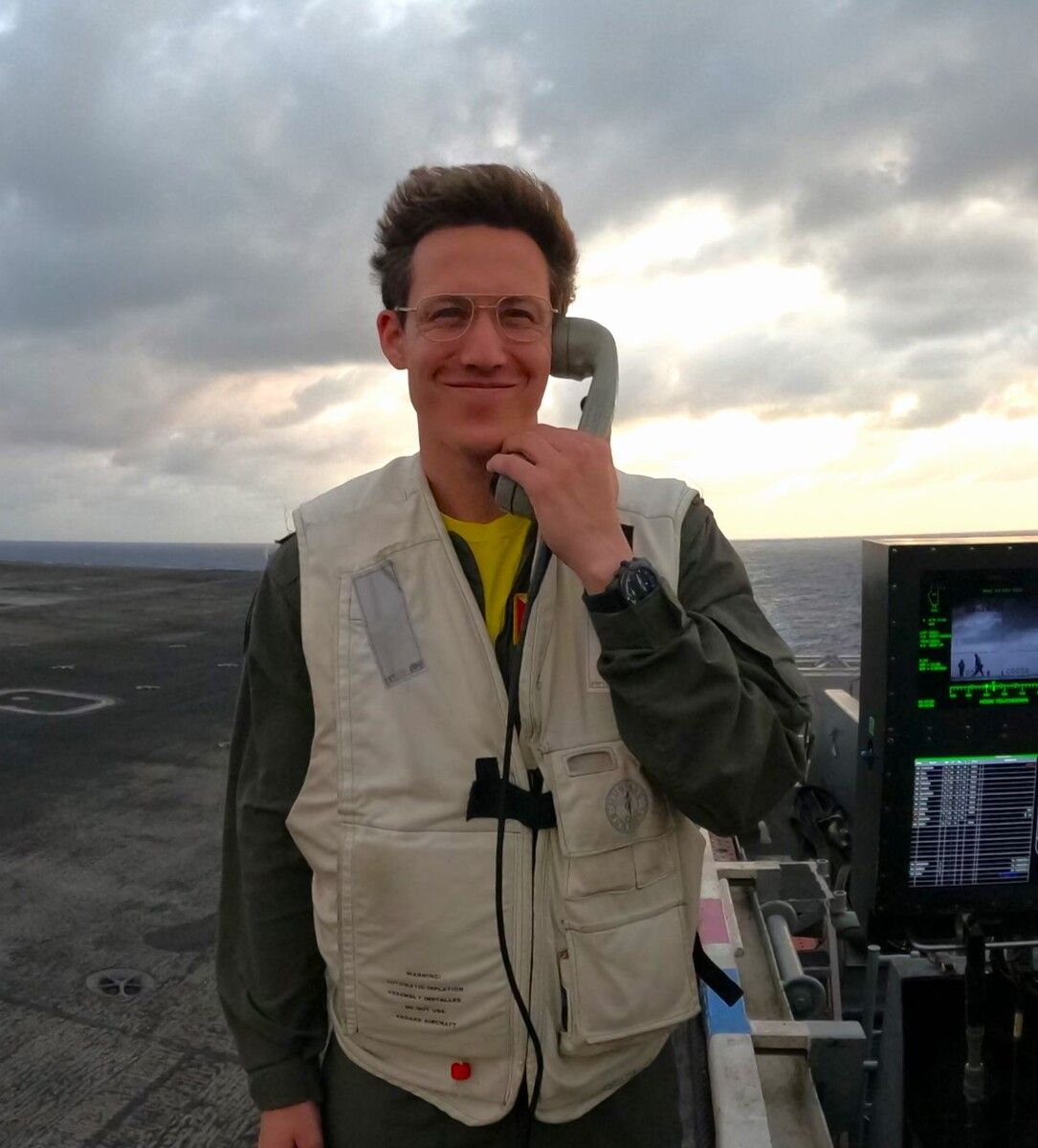
Editor’s Brief1
Last Week, we looked at Dominion Dynamics, a company building to become the first Canadian Neoprime.
This week we’re back in the directed energy space with a look at Aurelius Systems

This issue is sponsored by Alumni Ventures — Get early access to their U.S. Strategic Tech deal flow, details below.

Signal Brief: Aurelius Systems
Aurelius Systems is developing autonomous, edge-deployed directed energy weapons (DEW) designed specifically for Group 1 and 2 Counter-UAS (C-UAS) missions. The company fuses commercial off-the-shelf hardware, high-power fiber lasers, and a machine-learning targeting stack to drive the marginal cost of a shootdown down to the cost of the electricity required to fire the laser.
Origins & Vision
Founded in May 2024 by Michael LaFramboise and John Marmaduke, Aurelius set out to build the air-defense that was cheap, mobile, and autonomous. LaFramboise spent time in Detroit automotive manufacturing and several years at Coherent in high-power industrial lasers while CTO John Marmaduke spent 6 years at Ford Motor company as a Senior Software Engineer.
In July 2024, the company announced a $2 million Pre-Seed funding round, and by February 2025, Aurelius successfully demonstrated its initial laser weapon system at the Joint Interagency Field Experimentation (JIFX) 25-2 event at Camp Roberts. In October of the same year, the company won the U.S. Army's first-ever FUZE competition, an iteration of the xTechDisrupt program held at the AUSA conference
Last month, the Archimedes platform completed successful live-fire engagements against more than 20 quadcopters at the DoD's Technology Readiness Experimentation (T-REX) 26-2 event at Camp Atterbury. The company also launched Aurelius Manufacturing in April of this year, a new division to create a fully domestic, ITAR-compliant production line for high-power fiber laser sources, directly mitigating supply chain reliance on foreign entities.
Key Takeaways
Bringing Down The Cost Curve— With a near-bottomless magazine at ~$0.10 per shootdown, Archimedes is a cost effective detect–classify–track–engage kill chain with no human operator
Dedicated Manufacturing Division — Vertically integrating the production of the core high-power fiber laser source modules, beginning with compact, rack-integrated modules built to military specifications
DoD demand signal — Selected as an awardee on the Missile Defense Agency’s Scalable Homeland Innovative Enterprise Layered Defense (SHIELD) contract
Tech Radar:
An edge-deployed modular turret fusing a high-power fiber laser, optical sensors, and an AI autonomy stack into a sub-30 kg, air-cooled package mountable on vehicles, fixed sites, or forward bases.
Key Capabilities
Passive Optical Sensing: Continuously scans airspace and classifies threats by kinematics without emitting RF.
Operator-Free Engagement: Real-time control loops aim and hold the beam on a vulnerable point until structural failure, with no human in the loop.
COTS-First Architecture: Automotive and industrial components cut COGS, shorten the manufacturing timeline, and keep parts available for field repair.
Tactical Power Architecture: Can draw power from grid, generator, or battery, and integrates Chariot Defense's "Amphora" expeditionary battery
Launched in Detroit in April 2026 to build high-power fiber-laser source modules in the U.S., starting with a compact, rack-integrated, multi-kilowatt module to military spec. The thesis is ITAR-compliant source modules with end-to-end traceability, insulated from foreign allocation, plus a dual-use industrial laser business as a hedge against federal budget timing.
Market Signals
Funding & Growth
Total Funding: ~$12M across two rounds
Latest Round: $10M Seed (Sep 2025)
Notable Investors: General Catalyst, Draper Associates, Outlander VC, Squadra, Decisive Point, Alumni Ventures
Valuation: Undisclosed
Contracts & Government Traction
MDA SHIELD IDIQ — A seat on a 10-year, $151B shared-ceiling vehicle for the Golden Dome architecture. MDA awarded seats to 2,000-plus of 2,400-plus proposers. No funds obligated at base award—a hunting license, not revenue.
Army FUZE / xTechDisrupt — Won the Army's first FUZE competition at AUSA (Oct 2025); xTechDisrupt awarded up to eight winners $62,500 each.
DIU U.S.–Singapore Joint Challenge — Named among companies sharing $130,000; company-specific amount undisclosed.
JIFX 25-2 (Camp Roberts, Feb 2025): First laser weapon system used at a JIFX event; engaged Group 1 quadcopters in rain and wind.
T-REX 26-2 (Camp Atterbury, Jun 2026): Engaged 20+ quadcopters and 5+ previously unseen Army-supplied drones.

Defense Tech Signals and Alumni Ventures are offering readers early access to high-growth startup opportunities, including companies like Cambium, which recently raised $100M and was available to AV Syndicate members before the round.
Join the AV Syndicate to invest alongside top venture firms like Founders Fund, General Catalyst, and Andreessen Horowitz (a16z) in some of today's most exciting U.S. Strategic Tech companies.
You get:
• Curated deal flow of high-potential U.S. Strategic Tech startups
• No cost and no commitment to join
• The flexibility to invest only if a company excites you
Don’t miss your chance to access opportunities before they close.
Looking Ahead
On May 16, 1960, Theodore Maiman at Hughes Research Laboratory fired the first working laser. By the end of 1962, ARPA (now DARPA) was running two programs to weaponize it: Project Seaside and Project Defender. Between 1960 and 1980, the government spent roughly $2.4 billion on laser development.
Then on March 23, 1983, President Reagan stood in front of the country and asked: "What if free people could live secure in the knowledge... that we could intercept and destroy strategic ballistic missiles before they reached our own soil?"
The Strategic Defense Initiative made directed energy its centerpiece: space-based chemical lasers, ground-based free electron lasers, neutral particle beams, even nuclear-pumped concepts. Over nine years, SDIO spent $4.9 billion on directed energy across five programs.
And none of it was ever fielded.
SDI set the template for how directed energy fails. Pick the hardest possible target (an ICBM in boost phase, from orbit) and demand strategic-scale performance from immature technology.
Sixty-six years after that first laser, the Pentagon's fielded directed-energy inventory is just nineteen systems, most deployed for test and evaluation: eight ODINs, one HELIOS, one solid-state laser on an LPD, five CLaWS, three HELWS, and a single THOR.
So why are we still trying to make lasers work? Speed-of-light engagement means no lead angle, no time of flight, no ballistic arc. Anyone who has worked a gun solution against a maneuvering target knows what it means to delete that entire problem set.
The rest of the engineering has largely been sorted too; power, thermal management, reliability, integration. (We proved the concept in 1973 with the first laser shootdown of a drone.) But sorted in the lab. In the real world, a requirements culture keeps asking the beam to do too much.
Instead of using lasers to kill ICBMs in boost phase from orbit, Aurelius wants a laser to kill a plastic quadcopter at a kilometer.
What’s different today? Industrial fabricators spent two decades driving fiber laser cost down and reliability up because cutting steel is a commercial business. The automotive industry paid for the compute and computer vision a kill chain needs at the edge. The EV market paid for high-voltage battery architecture.
Archimedes is an integration play on those three curves. Aurelius picked the smallest, softest, slowest target class in the sky and built a system matched to technology that exists, instead of a requirement waiting for physics to catch up.
Challenges
Operational envelope. Weather, obscurants, dwell time, line-of-sight, thermal, and safety constraints can turn a strong range system into a marginal field one.
Manufacturing execution. Vertical integration into domestic fiber-laser production is strategically smart and execution-heavy
Sixty years of overpromise. From SDI through the Airborne Laser, directed energy has a track record of consuming billions and delivering demos, and every program office remembers it
Bottom Line:
Aurelius Systems is a bet that directed energy's sixty-year problem was never the beam but the requirements. By aiming at the smallest, cheapest target class in the sky and integrating commercial curves the defense budget never had to pay for, the company has produced more live-fire validation in two years than most laser programs manage in ten.
1 The views expressed in this newsletter are my own and do not represent the views of the U.S. Navy, Department of Defense, or any government agency. Mention of companies, technologies, or products is not an endorsement or recommendation. The content is for informational purposes only and should not be considered investment advice.